Tuesday, July 26, 2016
Is software still patentable?
Phil Hunt of Rylander and Associates PC answers the question, is software still patentable in light of the recent court ruling in his Vancouver Business Journal article.


Friday, May 20, 2016
Wednesday, January 16, 2013


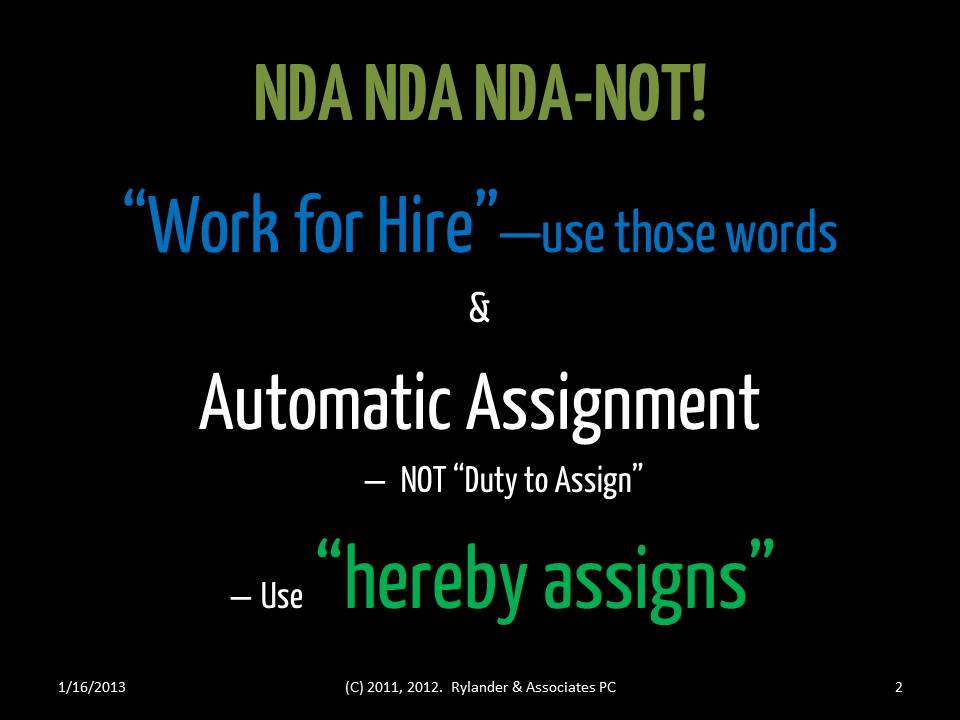
Thursday, January 3, 2013


Wednesday, February 1, 2012
Patent Laws' Fall from Grace-Part III-A Graceless Mess
President Obama signed the Leahy-Smith America Invents Act ("2011 AIA") into law on September 16, 2011, making the largest change to patent law in half a century. The last whole sale change to patent law was the 1952 Patent Act. That act provided for the one year statutory bar related to inventions on sale, printed publications, and public use--also known as the one year grace period.
The sea-change represented by the 2011 AIA, is felt keenly in the change to the one year grace period. Simply put, it is no longer clear what falls within the one year grace period, or whether it is even available at all.
The 2011 AIA states in pertinent part that there is NO grace period with a highly complicated, and currently un-interpreted, exception:
"§102. Conditions for patentability; novelty"(a) NOVELTY; PRIOR ART. A person shall be entitled to a patent unless—"(1) the claimed invention was patented, described in a printed publication, or in public use, on sale, or otherwise available to the public before the effective filing date of the claimed invention;...***"(b) EXCEPTIONS. …(1) … A disclosure made 1 year or less before the effective filing date of a claimed invention shall not be prior art to the claimed invention under subsection (a)(1) if—"(A) the disclosure was made by the inventor or joint inventor or by another who obtained the subject matter disclosed directly or indirectly from the inventor or a joint inventor; or"(B) the subject matter disclosed had, before such disclosure, been publicly disclosed by the inventor or a joint inventor or another who obtained the subject matter disclosed directly or indirectly from the inventor or a joint inventor.
This “exception” to an exception inserts a lot of ambiguity into the one year grace period. What is the difference between “the disclosure”, the “claimed invention” and “the subject matter disclosed”? What is a “public disclosure”? What does it mean that the disclosure can be “by another who obtained … directly or indirectly from the inventor”?
For example, does the “disclosure” or the “subject matter disclosed” have to be enabling (within the meaning of 35 USC Sec. 112) in comparison to the eventually “claimed invention”? Is a “public disclosure” of the “claimed invention” or of the “subject matter”, or “other”? And is the “public disclosure” the same thing as a “patent[]”, “printed publication”, a “public use”, a product “on sale”, or something “otherwise available to the public”? What is covered by the category of a disclosure “by another who obtained…indirectly from the inventor”? Does this cover illicit acts? Breaches of non-disclosure agreements?
It took the Supreme Court over 10 years to substantively rule on key sections of the 1952 Patent Act. If it takes over 10 years to get clear and final guidance on the questions above, inventors will be in a state of limbo until after 2022. This guarantees years of litigation and attorneys’ fees. A graceless mess indeed.
Friday, January 20, 2012
Patent Laws' Fall from Grace-Part II-A Foreign Lack of Grace
The one year grace period provided in U.S. patent law for at least the past half century never coincided with foreign patent law. In short, there is, and remains, a lack of a clear foreign grace period. Some countries provide the same one year grace period (prior to the most recent change in September 2011), but for different activities, other than offer for sale or public use. Some countries offer a grace period for offers for sale or public use, but for a shorter time period. Some countries offer no grace period. Keeping up with all the different countries and their differing, or nonexistent, grace periods can be a momentous task---among other things, other countries pass and modify laws the same as our country--so to a certain extent, a moving target aspect exists.
This complexity was somewhat mitigated, but also exacerbated, by the international treaty that provided that filing a foreign patent application within one year of filing a domestic patent application (and claiming priority to the domestic patent application) allowed the foreign application to have the effective date of the domestic patent application, i.e., one year earlier.
The result of that treaty was the creation of two one year bars. The US public use/offer for sale one year bar, and the foreign patent filing claiming prior to the US patent application one year bar. but the foreign patent application may not have the same grace periods that the US patent application enjoyed, so even though the foreign patent application was filed within one year of the US patent application (and claimed priority to it), the foreign application may still be invalid if the inventor engaged in public use or offers for sale within the one year prior to filing the US patent application, even though the US patent application would not be invalid. Confused enough? It's like a bizarre Rube Goldberg machine.
As a general rule, with many exceptions that your patent attorney will have to research, do NOT rely on the existence of any foreign grace period.
Saturday, January 14, 2012
Patent Laws' Fall from Grace-Part I: The Golden Age
For at least half a century, U.S. patent law provided a fairly clear one year grace period from public use of, or offer for sale of, a utility invention before a patent application on the invention was required to be filed. In other words, the inventor could publicly use and/or put the product for sale on the marketplace and not lose any domestic patent rights, so long as the patent application was filed within 365 days of the very first time the use was public or the product was offered for sale. The consequences for violating this grace period were lost of patent rights--the invention became dedicated to the public and free for all to use.
This strict grace period was enforced after-the-fact. The inventor was required to swear in a declaration, under penalty of Federal criminal law, that the inventor would disclose all material information to the patent office--public use or offers for sale more than year before filing the application being clear material information.
If the inventor didn't tell the patent office, no one was the wiser--until litigation erupted and the inventor tried to enforce the patent in an infringement suit. Then a well funded defendant with a competent legal team would investigate every nook and cranny, interview friends and relatives, and quite possibly turn up the undisclosed public use or offer for sale. The patent would likely be held invalid, and the inventor might even have to pay the defendant's gargantuan legal fees. Thus were the strictures of the one year grace period enforced.
That was then. The Leahy-Smith America Invents Act signed into law on September 16, 2011 changes all that, as discussed in the following posts.
Thursday, February 24, 2011
Tuesday, July 27, 2010
Search Me: IP Searches in Brief
Intellectual property practice is rife with searches. We list below the more common searches that the entrepreneur will come into contact with or have occasion to use.
PATENT SEARCHES. There are different types of patent searches depending on what is being searched for.
Novelty or Patentability Searches. These searches help to answer the question: Can I get a patent on my invention. These searches encompass all prior art, whether dead, invalid, US or foreign. These searches typically only answer the first of the two main patentability questions, that is, whether the invention is novel in light of the prior art. The second question, much more murky, is whether the invention is obvious in light of the prior art. These searches cannot definitively answer that second question, but can give guidance to a patent professional, and perhaps suggest design around tactics.
Infringement Searches. Infringement searches are also called Right-to-Use Searches, Clearance Searches, or Freedom of Operation Searches. Whether you wish to get a patent or not, you will wish to know if producing and marketing your invention may infringe the claims of someone else’s patent. These searches are more narrow, because you don’t care about dead or expired patents, the relevant date range is the last 20 years, and if you are only interested in the US market, you don’t care about foreign patents. These searches are also more narrow than novelty and invalidity searches in that you only care about patents, not other types of prior art. Like invalidity searches, these searches focus on individual claims of patents.
Invalidity Searches. Invalidity searches seek to answer the question: Was the patent issued erroneously such that it should be invalidated. These searches, which focus on individual claims in a patent, are typically more time consuming than a novelty search. The focus is on finding prior art that existed before the patent application was filed, and which was not cited to or considered by the Patent Office during the examination of the patent application. Just like novelty searches, invalidity searches are not limited to patents and patent applications, but anything which may be prior art, such as an industry report, or pre-existing apparatus, or trade journal article.
State-of-the-Art Searches. These are very different types of patent searches. The point of these searches is to allow researchers and developers to see what is the current state of development in a particular field of endeavor.
TRADEMARK SEARCHES. Also called Trademark Clearance Searches and Name Availability Searches, this type of search is performed to see if a name is appropriable for use as a trademark, both from the perspective of eligibility for registration and from the perspective of avoiding using someone else’s mark. These searches typically search not only State and Federal trademark and corporate name databases, but also yellow pages, phone books, and the Internet, among other sources.
COPYRIGHT SEARCHES. Copyright searches are often the hardest of all searches to be confident about. You can search titles and authors at the Copyright Office, and you can do Google, Google/Scholar, and Google/Book searches. There also exist specialty libraries for various types of artists that can and should be checked, such as for music and the visual arts. But any type of search will necessarily omit huge swaths of published material that simply (a) has not been registered for copyright (even though it is copyrighted) and/or (b) has never been put on the internet.
PATENT SEARCHES. There are different types of patent searches depending on what is being searched for.
Novelty or Patentability Searches. These searches help to answer the question: Can I get a patent on my invention. These searches encompass all prior art, whether dead, invalid, US or foreign. These searches typically only answer the first of the two main patentability questions, that is, whether the invention is novel in light of the prior art. The second question, much more murky, is whether the invention is obvious in light of the prior art. These searches cannot definitively answer that second question, but can give guidance to a patent professional, and perhaps suggest design around tactics.
Infringement Searches. Infringement searches are also called Right-to-Use Searches, Clearance Searches, or Freedom of Operation Searches. Whether you wish to get a patent or not, you will wish to know if producing and marketing your invention may infringe the claims of someone else’s patent. These searches are more narrow, because you don’t care about dead or expired patents, the relevant date range is the last 20 years, and if you are only interested in the US market, you don’t care about foreign patents. These searches are also more narrow than novelty and invalidity searches in that you only care about patents, not other types of prior art. Like invalidity searches, these searches focus on individual claims of patents.
Invalidity Searches. Invalidity searches seek to answer the question: Was the patent issued erroneously such that it should be invalidated. These searches, which focus on individual claims in a patent, are typically more time consuming than a novelty search. The focus is on finding prior art that existed before the patent application was filed, and which was not cited to or considered by the Patent Office during the examination of the patent application. Just like novelty searches, invalidity searches are not limited to patents and patent applications, but anything which may be prior art, such as an industry report, or pre-existing apparatus, or trade journal article.
State-of-the-Art Searches. These are very different types of patent searches. The point of these searches is to allow researchers and developers to see what is the current state of development in a particular field of endeavor.
TRADEMARK SEARCHES. Also called Trademark Clearance Searches and Name Availability Searches, this type of search is performed to see if a name is appropriable for use as a trademark, both from the perspective of eligibility for registration and from the perspective of avoiding using someone else’s mark. These searches typically search not only State and Federal trademark and corporate name databases, but also yellow pages, phone books, and the Internet, among other sources.
COPYRIGHT SEARCHES. Copyright searches are often the hardest of all searches to be confident about. You can search titles and authors at the Copyright Office, and you can do Google, Google/Scholar, and Google/Book searches. There also exist specialty libraries for various types of artists that can and should be checked, such as for music and the visual arts. But any type of search will necessarily omit huge swaths of published material that simply (a) has not been registered for copyright (even though it is copyrighted) and/or (b) has never been put on the internet.
Wednesday, June 16, 2010
A Plethora of Patent Applications
Many entrepreneurs, seeking knowledge and thrift in cost, research the patent process online. Invariably, they come away with spotty information and even that is usually wrong. One area of confusion is the type of patent applications that are available.
This entry provides a list of some of the types of patent applications that entrepreneurs can come across:
- Provisional: these applications do not yield “provisional patents”. Instead, they are temporary patent applications that give a priority date for only so much as is actually disclosed and enabled in the application, and it is only good for one year. If a nonprovisional is not filed within that year, the priority date is blown. Many entrepreneurs seeking self-help damage or destroy whatever intellectual property rights they may have through ill-considered use of the provisional patent application procedure.
- Nonprovisional: these are regular patent applications, whether utility, design, or plant, that are examined by the Patent Office.
- International: these are various species of patent applications that can be Patent Cooperation Treating (PCT) applications filed at the World Intellectual Property Office (WIPO), or foreign applications, or regional applications.
- PCT international: these are international patent applications filed under the PCT with a WIPO Receiving Office. They are useful for countries that are signatories to the PCT.
- Foreign: these are applications filed in foreign countries.
- Regional: these are applications filed in foreign regions that have set up regional reviewing authorities, such at the European Patent Organization (EPO).
- Non-PCT international: these are foreign applications filed with Countries that re not signatories to the PCT.
- Utility: these are what mot people think of when they think of inventions. These are regular patent applications that are not filed as design (ornamental) patent applications or plant patent applications.
- Design: these are patent applications filed under the design patent application procedure and are for ornamental features of functional articles.
- Plant: these are patent applications covering organic plants (as opposed to, for example, factories).
- Continuation: these are applications that are filed during, and claiming priority to, a pending patent application.
- Continuation-in-part: these are continuation applications that include additional new matter.
- Divisional: these are continuation applications that essentially divide the original application into two different applications two cover two different inventions.
- CPA: these are patent applications, no longer in use, which essentially continued examination of the original patent application.
- Substitute: these are a misnomer in the sense that it is not a substitute patent application, but rather a substitute specification replacing the specification in a patent application.
Important note: This list is not comprehensive.
Saturday, May 29, 2010
What's the bottom line?
Clients invariably ask how much it will cost to patent an invention. Sometimes the question comes after a lengthy explanation of patent law and the patent prosecution process. Sometimes it comes insistently by a first time caller, reluctant to disclose even their name. People want an estimate, a flat price, a round figure, a budget. Something that they can metricize and hang their hat on.
The short answer is: we don't know for certain. Patent application drafting and patent prosecution have so many variables, many of which are not under the control of the patent attorney, that any estimate is a guess at most. The most a patent attorney can ever do, if they are not negotiating a flat fee (or maximum/minimum), which has its own hazards, is provide an estimate of what the average in a particular area of technology has historically been.
Entrepreneurs however have the ability to manage costs based on choices they make. To explain this, it is necessary to understand some of the factors that go into cost:
(1)Prior art search: whether a prior search is ordered, and how extensive; whether the client wants the patent attorney to evaluate the prior art search results; whether the prior art search results will require a design around; whether the client wishes the patent attorney to start drafting the patent application prior to the prior art search results being returned.
(2)Stage of invention and production: whether the client has built a prototype or is working off unproven sketches; whether the client has made a production model; how complete is development of the invention; whether the client has a business plan.
(3)Complexity of invention and technology: what art area is the invention in—mechanical, electrical, computer science, material science, chemical, etc.; does it have multiple embodiments; how key is the invention to the business plan.
(4)The attorney fees per hour or per embodiment.
(5)How many inventors are there and are their relative contributions known.
(6)Whether the client is defensively applying for a patent application or offensively.
(7)Whether the client wishes to pursue foreign patent rights.
(8)Whether the invention is on the market now or has it otherwise been publicly used or made known to others not under a duty of confidentiality.
(9)Whether the client wishes to file a provisional or nonprovisional patent application.
(10)Whether other government agencies need to be involved (such as the FDA or the Department of Agriculture).
(11)Whether the invention implicates national security.
(12)Whether the invention is partially funded with Federal money.
(13)Whether the client is a small entity or a large entity.
This is not a complete list, but it does provide the entrepreneur with factors which can be used to help manage costs. Looking at the list, it should be obvious that entrepreneurs have a significant ability to manage patent costs especially in categories 1, 2, 3, 7, and 9. In short, if there is a prior art search, it will cost more. If there are multiple embodiments, it will cost more. If the client keeps adding to the invention, improving, and making changes, after the patent drafting has started, it will cost more. If the client wishes to pursue foreign patent rights, it will cost more. If the invention is incipient instead of developed, it will cost more.
One scenario frustrating both for the client and the patent attorney, is the client who comes in, very enthusiastic, who wants an estimate, but has not thought through any of these factors, and then makes multiple changes and adds embodiments after patent application drafting has started. The estimates then bear no relation to the work being done and the client gets a significantly higher bill.
Wise entrepreneurs, as mentioned in previous blogs, will make a comprehensive business plan. That plan should certainly include consideration of the above factors, at a minimum.
The short answer is: we don't know for certain. Patent application drafting and patent prosecution have so many variables, many of which are not under the control of the patent attorney, that any estimate is a guess at most. The most a patent attorney can ever do, if they are not negotiating a flat fee (or maximum/minimum), which has its own hazards, is provide an estimate of what the average in a particular area of technology has historically been.
Entrepreneurs however have the ability to manage costs based on choices they make. To explain this, it is necessary to understand some of the factors that go into cost:
(1)Prior art search: whether a prior search is ordered, and how extensive; whether the client wants the patent attorney to evaluate the prior art search results; whether the prior art search results will require a design around; whether the client wishes the patent attorney to start drafting the patent application prior to the prior art search results being returned.
(2)Stage of invention and production: whether the client has built a prototype or is working off unproven sketches; whether the client has made a production model; how complete is development of the invention; whether the client has a business plan.
(3)Complexity of invention and technology: what art area is the invention in—mechanical, electrical, computer science, material science, chemical, etc.; does it have multiple embodiments; how key is the invention to the business plan.
(4)The attorney fees per hour or per embodiment.
(5)How many inventors are there and are their relative contributions known.
(6)Whether the client is defensively applying for a patent application or offensively.
(7)Whether the client wishes to pursue foreign patent rights.
(8)Whether the invention is on the market now or has it otherwise been publicly used or made known to others not under a duty of confidentiality.
(9)Whether the client wishes to file a provisional or nonprovisional patent application.
(10)Whether other government agencies need to be involved (such as the FDA or the Department of Agriculture).
(11)Whether the invention implicates national security.
(12)Whether the invention is partially funded with Federal money.
(13)Whether the client is a small entity or a large entity.
This is not a complete list, but it does provide the entrepreneur with factors which can be used to help manage costs. Looking at the list, it should be obvious that entrepreneurs have a significant ability to manage patent costs especially in categories 1, 2, 3, 7, and 9. In short, if there is a prior art search, it will cost more. If there are multiple embodiments, it will cost more. If the client keeps adding to the invention, improving, and making changes, after the patent drafting has started, it will cost more. If the client wishes to pursue foreign patent rights, it will cost more. If the invention is incipient instead of developed, it will cost more.
One scenario frustrating both for the client and the patent attorney, is the client who comes in, very enthusiastic, who wants an estimate, but has not thought through any of these factors, and then makes multiple changes and adds embodiments after patent application drafting has started. The estimates then bear no relation to the work being done and the client gets a significantly higher bill.
Wise entrepreneurs, as mentioned in previous blogs, will make a comprehensive business plan. That plan should certainly include consideration of the above factors, at a minimum.
Tuesday, January 12, 2010
The Entrepeneur's Beginning Startup Checklist
Many beginning entrepreneurs find that having a checklist to work from helps organize the tasks that need to be accomplished. Basic checklists like the following are used to help get the ball rolling. Note this is not a comprehensive list and there is some item overlap. The inclusions in the list, and the substantive acts and contents of each document on the list, can change depending on the jurisdiction. Also, while this list is enumerated, the enumeration is for convenience only. Different individuals will reach different starting points depending on the moment of inspiration.
- Comprehensive Business Plan (how will you make money)
- IP Protection in place, including some or all of, trademark(s) registrations applied for, proper trademark marking of goods and services, name availability search(es), copyright registration(s) applied for, patent application(s) filed, work for hire and assignment agreements for employees and contractors executed, assignments on record at the appropriate recording agency, patentability search and freedom of operation opinion
- Nondisclosure agreements ready for investors, evaluators, consultants, and other third-parties to sign
- Business formation documents in place, usually including incorporation/certificate of formation, articles of incorporation/membership agreement, first organizational meeting and adoption of bylaws, issue certificates of ownership/share certificates and update register shareholders agreement/membership agreement(including clauses for assigning intellectual property, work for hire, nondisclosure, noncompetition, and, among others, buy sell), buy-sale and valuation agreement, technology transfer agreement
- Employment agreements in place (including clauses for assigning intellectual property, work for hire, nondisclosure, noncompetition)
- Asset listing (an IP audit)
Friday, January 1, 2010
New Years Day 2010
Gross mass misconceptions underline the need for detailed and well written legal documents. Take for example the "new" decade of 2010-2019. In fact, we are not yet in the new decade, which does not begin until 2011. This is because there was no year "0". Before the year "1" AD there is the year "1" BC. Thus, the first year in the modern calendar is year "1". Which means the first decade, the first ten years, ended at the end of year "10", and the second decade did not begin until the year "11". Accordingly, the second millennium did not begin until 2001, and the second decade in the second millennium does not begin until "2011". Nevertheless, largely because of the ignorance of the media, everybody believes the second decade has begun.
What is the significance of this? That errors in dates and deadlines are extremely common and constant vigilance in drafting legal documents is required.
Law is beset by legal deadlines and drop dead dates. Intellectual property law is no exception, and in fact has more than the average number of kill dates, with very dire consequences. Just by way of a few examples, for patents there is the one year statutory bar deadline, the one year conversion from provisional to nonprovisional deadline, the one year foreign application filing deadline, the 20 and 30 month national stage filing deadlines, the six month response deadlines, etc. (By the way, the large number of myriad kill dates in patent law are a good reason why inventors should not go it alone). A particularly knotty deadline is appealing de novo a BPAI decision, which must be done within two months. Many practitioners assume that "two months" means 60 days, with 30 days a month. But in fact, the two months means two actual months. Thus, if the two months after the decision include a month that has 31 days, then the appeal can be, for example, in 61 or 62 days (if there are two months sequentially of 31 days each, like July and August).
What is the significance of this? That errors in dates and deadlines are extremely common and constant vigilance in drafting legal documents is required.
Law is beset by legal deadlines and drop dead dates. Intellectual property law is no exception, and in fact has more than the average number of kill dates, with very dire consequences. Just by way of a few examples, for patents there is the one year statutory bar deadline, the one year conversion from provisional to nonprovisional deadline, the one year foreign application filing deadline, the 20 and 30 month national stage filing deadlines, the six month response deadlines, etc. (By the way, the large number of myriad kill dates in patent law are a good reason why inventors should not go it alone). A particularly knotty deadline is appealing de novo a BPAI decision, which must be done within two months. Many practitioners assume that "two months" means 60 days, with 30 days a month. But in fact, the two months means two actual months. Thus, if the two months after the decision include a month that has 31 days, then the appeal can be, for example, in 61 or 62 days (if there are two months sequentially of 31 days each, like July and August).
Wednesday, June 17, 2009
Divorce and Intellectual Property
A recent opinion highlights the ugliness of intellectual property when divorce occurs. The beloved Johnathan Livingstone Seagull was the rope in a tug of war between the author Richard Bach, and his ex, Ms. Parrish, in the Washington Court of Appeals case Bach v. Parrish,
60406-6-I (2008). Ms. Parrish had helped Mr. Bach out by buying the copyright rights to the book when Mr. Bach went through bankruptcy shortly after they were married, using her separate funds. She then granted him 50% of the rights. They then divorced and agreed as part of the divorce to share the rights to the book as tenants in common. They then executed a comprehensive settlement dividing up the rights including rights to accrued causes of action such as copyright infringement. There was an infringer. It resulted in a monetary settlement. Bach and Parrish fought over who got what. Ultimately, Bach won because the divorce agreement was comprehensive and clearly gave him the accrued causes of action. It also required resolution by arbitration before a specific judge. All of which the Court of Appeals agreed to.
Reading this case displays only some of the bizarre tangles that occur when divorce enters the world of intellectual property. Washington is a community property state. Thus, Ms. Parrish was able to purchase and own because of her separate funds. Would she have been unable to get individual rights in a non-community property state. There are numerous questions of who owns what in a marriage, depending on the State and the type of intellectual property.
One clear result from the case that entrepreneurs should take away, Bach was definitely benefited by having a well drafted agreement that contained an arbitration clause.
60406-6-I (2008). Ms. Parrish had helped Mr. Bach out by buying the copyright rights to the book when Mr. Bach went through bankruptcy shortly after they were married, using her separate funds. She then granted him 50% of the rights. They then divorced and agreed as part of the divorce to share the rights to the book as tenants in common. They then executed a comprehensive settlement dividing up the rights including rights to accrued causes of action such as copyright infringement. There was an infringer. It resulted in a monetary settlement. Bach and Parrish fought over who got what. Ultimately, Bach won because the divorce agreement was comprehensive and clearly gave him the accrued causes of action. It also required resolution by arbitration before a specific judge. All of which the Court of Appeals agreed to.
Reading this case displays only some of the bizarre tangles that occur when divorce enters the world of intellectual property. Washington is a community property state. Thus, Ms. Parrish was able to purchase and own because of her separate funds. Would she have been unable to get individual rights in a non-community property state. There are numerous questions of who owns what in a marriage, depending on the State and the type of intellectual property.
One clear result from the case that entrepreneurs should take away, Bach was definitely benefited by having a well drafted agreement that contained an arbitration clause.
Wednesday, April 22, 2009
Rescue Me
Businesses seeking search engine optimization through use of keywords were dealt a blow by the US Court of Appeals for the Second Circuit on April 3, 2009. In Rescuecom Corp. v Google, Inc., the Second Circuit reversed the lower court’s dismissal of Rescuecom's suit against Google for Google's use of the term “Rescuecom” to trigger sponsored links through Google's Adwords and keyword suggestion programs. The lower court had dismissed the suit ruling that the Google programs use of the terms was not "use in commerce". The Second Circuit reversed, and in doing so, joined the other courts, notably the Ninth Circuit, that have ruled that use of keywords can be “use in commerce” for purposes of liability for infringement under the Federal Lanham Act.
What are the implications? First, given the wide spectrum of trademark protectabilty, from no-protection generic terms to highly protectable fanciful or arbitrary terms, the business using keywords must navigate a minefield. How do you know if a term is claimed as a trademark by someone else? Certainly a search on the Federal register can yield those marks for which someone has sought Federal registration, but the Lanham Act allows suit for unregistered marks, such as State registered marks or common law marks. Searching for common law marks can be an unwieldy and expensive beast, and if the business owner has to do it for every term it wishes to use as a Google Adword, then marketing costs for internet advertising will quickly add up.
Second, the decision ruling keyword use to be "use in commerce" seems at odds with the Federal Trademark Office interpretation of "use in commerce". To get a mark registered, the applicant needs to show that the mark has been "used in commerce" for the particular class of goods or service for which registration is sought. The Trademark Office does not accept keyword use as acceptable proof of use. But how can the Trademark Office continue to take this position when the Federal Courts of Appeals rule that keyword advertising is "use in commerce". This conflict is ripe for resolution, which doesn't currently appear anywhere near.
Due diligence before use of a term in advertising that is even remotely suspected as being a possible trademark of another now seems to be the order of the day. What constitutes due diligence, however, is a topic for another day.
What are the implications? First, given the wide spectrum of trademark protectabilty, from no-protection generic terms to highly protectable fanciful or arbitrary terms, the business using keywords must navigate a minefield. How do you know if a term is claimed as a trademark by someone else? Certainly a search on the Federal register can yield those marks for which someone has sought Federal registration, but the Lanham Act allows suit for unregistered marks, such as State registered marks or common law marks. Searching for common law marks can be an unwieldy and expensive beast, and if the business owner has to do it for every term it wishes to use as a Google Adword, then marketing costs for internet advertising will quickly add up.
Second, the decision ruling keyword use to be "use in commerce" seems at odds with the Federal Trademark Office interpretation of "use in commerce". To get a mark registered, the applicant needs to show that the mark has been "used in commerce" for the particular class of goods or service for which registration is sought. The Trademark Office does not accept keyword use as acceptable proof of use. But how can the Trademark Office continue to take this position when the Federal Courts of Appeals rule that keyword advertising is "use in commerce". This conflict is ripe for resolution, which doesn't currently appear anywhere near.
Due diligence before use of a term in advertising that is even remotely suspected as being a possible trademark of another now seems to be the order of the day. What constitutes due diligence, however, is a topic for another day.
Saturday, February 14, 2009
Who you gonna call? Part I-Patents
People frequently ask what factors should go into evaluating and choosing a patent counsel. Patent work can be broken down into several areas, including licensing, prosecution, and litigation, among others. A deep technical understanding of the underlying art may be less necessary for licensing and litigation, assuming people familiar with the technology are accessible.
For this post, we will deal with choosing a patent prosecution counsel.
Technical understanding. For patent prosecution counsel, the technical understanding becomes more important, but again dependent on the area. For mechanical inventions, being an expert in that field of mechanical endeavor is probably unnecessary so long as the patent attorney is qualified for mechanical patents. Specialized understanding gets to be more important depending on the sophistication of the art. Cryptological software inventions, for example, probably require a skilled CS person who also has qualification in upper level (i.e., beyond engineer level) mathematics. Pharmaceuticals require not only the biochemical understanding, but access to attorneys skilled in FDA approvals. Numerous examples of the different arts, some requiring only basic qualification, and others requiring specialized qualification, exist.
In regards to efficiency/billing, and also in regard to ability, other qualities than specialized knowledge can be equally or more important such as learning speed, wheel-spinning, and legal conceptual understanding. The speed of learning—there are electrical engineers who can learn quickly, and those who cannot. Since all inventions are by their essence new, novel, and nonobvious, there will be learning regardless of specialized knowledge. Wheel-spinning--there are highly technically qualified attorneys who can take forever to sit down and hammer out the applications. Some people need to take a break every twenty minutes for a water cooler chat. Some like to do an application a day. Legal conceptual understanding—if the highly qualified technician just does not get the fact that patents are ultimately read by non-patent attorneys, and non-lawyers, the product will suffer and may require redrafting requests.
Anyone looking to choose patent prosecution counsel should also determine whether the counsel they consider is stuck in the past or married to inflexible platforms for performance and billing. Is the counsel open to alternative billing structures. Is the counsel open to re-constituted staffing of projects. The old firm tradition of billing hourly, and then maximizing profit by staffing a case with junior level attorneys all answering up the chain to a senior attorney, may not always be the most optimum. Is the counsel open to billing structures that provide motivation for efficiency.
Thus, in terms of selecting counsel for patent prosecution, while some breakdown should be made for specialized arts, to maximize value and minimize unnecessary fees, the evaluator should design a selection process that includes: (a) identifying a pool of base qualified counsel; (b) winnow the most efficient by focusing selection not on degrees or industry experience, but instead on factors which identify and quantify learning curve speed, work energy and motivation, and availability of senior attorneys who are experienced not only in prosecution, but also who have done licensing and who have actually conducted jury trials; and (c) determining whether in this winnowed group the counsel understands, is open to, and able to provide different billing structures so that in-house counsel can price and budget prosecution work in perspective to its worth to the company.
For this post, we will deal with choosing a patent prosecution counsel.
Technical understanding. For patent prosecution counsel, the technical understanding becomes more important, but again dependent on the area. For mechanical inventions, being an expert in that field of mechanical endeavor is probably unnecessary so long as the patent attorney is qualified for mechanical patents. Specialized understanding gets to be more important depending on the sophistication of the art. Cryptological software inventions, for example, probably require a skilled CS person who also has qualification in upper level (i.e., beyond engineer level) mathematics. Pharmaceuticals require not only the biochemical understanding, but access to attorneys skilled in FDA approvals. Numerous examples of the different arts, some requiring only basic qualification, and others requiring specialized qualification, exist.
In regards to efficiency/billing, and also in regard to ability, other qualities than specialized knowledge can be equally or more important such as learning speed, wheel-spinning, and legal conceptual understanding. The speed of learning—there are electrical engineers who can learn quickly, and those who cannot. Since all inventions are by their essence new, novel, and nonobvious, there will be learning regardless of specialized knowledge. Wheel-spinning--there are highly technically qualified attorneys who can take forever to sit down and hammer out the applications. Some people need to take a break every twenty minutes for a water cooler chat. Some like to do an application a day. Legal conceptual understanding—if the highly qualified technician just does not get the fact that patents are ultimately read by non-patent attorneys, and non-lawyers, the product will suffer and may require redrafting requests.
Anyone looking to choose patent prosecution counsel should also determine whether the counsel they consider is stuck in the past or married to inflexible platforms for performance and billing. Is the counsel open to alternative billing structures. Is the counsel open to re-constituted staffing of projects. The old firm tradition of billing hourly, and then maximizing profit by staffing a case with junior level attorneys all answering up the chain to a senior attorney, may not always be the most optimum. Is the counsel open to billing structures that provide motivation for efficiency.
Thus, in terms of selecting counsel for patent prosecution, while some breakdown should be made for specialized arts, to maximize value and minimize unnecessary fees, the evaluator should design a selection process that includes: (a) identifying a pool of base qualified counsel; (b) winnow the most efficient by focusing selection not on degrees or industry experience, but instead on factors which identify and quantify learning curve speed, work energy and motivation, and availability of senior attorneys who are experienced not only in prosecution, but also who have done licensing and who have actually conducted jury trials; and (c) determining whether in this winnowed group the counsel understands, is open to, and able to provide different billing structures so that in-house counsel can price and budget prosecution work in perspective to its worth to the company.
Monday, January 26, 2009
Patently Ridiculous
A series of more or less recent articles points to a troubling trend at the U.S. Patent Office. On January 5, 2009, PatentlyO reported a plummeting reversal rate at the Board of Patent Appeals and Interferences (BPAI). On January 8, 2009, PatentlyO reported a soaring appeal rate at the BPAI. The BPAI is the review board that reviews examiner rejections of patent application claims. Add to this state of affairs the troubling statistics, again reported at PatentlyO, showing a long wait time before the Examiner even gets to an office action. Similarly, the significant lag at the BPAI to even reach a decision on the merits, averaging 542 days (1 2/3 years), causes concern.
What does this mean? One conclusion is that there is a general belief that there are too many questionable Examiner rejections and that the only way to get a fair review is to appeal to the BPAI--hence, the soaring appeals. But because appeals are now sought more frequently, instead of after serious consideration, more questionable appeals are being filed--hence the plummeting reversal rate. And in both scenarios, it will be a long time before a decision because of the double lag times imposed upon Applicants by the Patent Office. The dedicated IP entrepreneur should increasingly expect to be "patent pending" for quite some time.
What does this mean? One conclusion is that there is a general belief that there are too many questionable Examiner rejections and that the only way to get a fair review is to appeal to the BPAI--hence, the soaring appeals. But because appeals are now sought more frequently, instead of after serious consideration, more questionable appeals are being filed--hence the plummeting reversal rate. And in both scenarios, it will be a long time before a decision because of the double lag times imposed upon Applicants by the Patent Office. The dedicated IP entrepreneur should increasingly expect to be "patent pending" for quite some time.
Monday, January 19, 2009
Naming your business
Picking a business and/or product name can be tricky. The more a name describes the product/business the more the name is not protectable. Pick a generic name and get instant recognition--but anybody else can use the name also. Building a reputation into an unusual nondescriptive name takes time and effort, but usually yields a more protectable name. But don't choose a name chosen by somebody else because then you risk trademark infringement/dilution liability. These precepts making choosing a name difficult. Nolo recently published an article on "Picking a Winning Name for your Business" which discusses some of these issues, and others.
Wednesday, December 17, 2008
Would you care if someone copied you?
Clients always downplay their product or their mark. It's not patentable, I didn't invent the wheel, anybody could do it. A simple question changes the mind: "Would you care if someone copied you? --copied your GUI (graphical user interface), your software engine, your product name or your company name." If you would care, then it is worth protecting. Whether talking about infringement, counterfeiting, misappropriation, et al., the normal term is "copying". When phrased that way, most people do care if their work is copied. That's where IP audits and business plans come in. IP audits review the business and see what IP protection may be needed, and the current state of the IP protection, among other things. It includes a review of employment agreements, shareholder agreements, vendor agreements, products and product names, websites and web engines, processes and procedures. What is your IP, how is it protected, how much protection can you afford, and which IP is at the core of your businesses profit-making? Once the IP is identified and the state of protection determined, budgets can be set. Of course, none of this matters if you don't care if someone copies you.
Tuesday, November 25, 2008
So I'm an inventor, what now?
You have invented the new widget. You have decided to seek patent protection. What now? Does the money just come when the invention is patented, or the application is filed? Does corporate America send you green mail when you notify them of your impending rights? Not hardly.
Patent attorneys are frequently asked for direction on how to take the invention from the patent stage to the market stage, but the fact is, patent attorneys are generally not business people and have little, or no, marketing and product development sense. Ultimately, the inventor turned budding entrepreneur either needs to be a business person, including marketing and financial savvy, become such a person, or hire/partner with such a person.
But first things first. How to go from invention to product. If you can, make a prototype. If you cannot, make a drawing. Here, the patent application can come in handy because if your patent attorney was sharp, he or she would have made sure there would good drawings to help support the patent application. Nice perspective, exploded, and/or perspective-in-use drawings can pay dividends, not just in understanding the invention, but in explaining what you want to a product developer. Remember, a picture is worth a thousand words. In either case (preferably after a patent application is filed), take the prototype or drawings (with serial number, title and filing date redacted) to the relevant professional for commercial product speccing (and make sure you use a very good, attorney vetted NDA). Who is the relevant professional? That depends on the art area. There are tons of plastics, machine shops, rotomolders and design shops around, many providing services specifically to inventors. If you need help, start with the Inventor's Digest magazine which has a host of ads and classifieds from such professionals, and which also has useful articles. You can also go to your State small business center. In Washington, the State has several Small Business Development Centers with certified business specialists whose very purpose is to help and point you in the right direction. The U.S. Small Business Administration has similar services. Public universities and community colleges also have business departments that can usually send you in the right direction. But there is no getting around the fact that you are going to have to use some elbow grease, make calls, and attend meetings. Remember Edison's adage: Genius is one percent inspiration and ninety-nine percent perspiration. This applies equally to entrepreneurship.
Patent attorneys are frequently asked for direction on how to take the invention from the patent stage to the market stage, but the fact is, patent attorneys are generally not business people and have little, or no, marketing and product development sense. Ultimately, the inventor turned budding entrepreneur either needs to be a business person, including marketing and financial savvy, become such a person, or hire/partner with such a person.
But first things first. How to go from invention to product. If you can, make a prototype. If you cannot, make a drawing. Here, the patent application can come in handy because if your patent attorney was sharp, he or she would have made sure there would good drawings to help support the patent application. Nice perspective, exploded, and/or perspective-in-use drawings can pay dividends, not just in understanding the invention, but in explaining what you want to a product developer. Remember, a picture is worth a thousand words. In either case (preferably after a patent application is filed), take the prototype or drawings (with serial number, title and filing date redacted) to the relevant professional for commercial product speccing (and make sure you use a very good, attorney vetted NDA). Who is the relevant professional? That depends on the art area. There are tons of plastics, machine shops, rotomolders and design shops around, many providing services specifically to inventors. If you need help, start with the Inventor's Digest magazine which has a host of ads and classifieds from such professionals, and which also has useful articles. You can also go to your State small business center. In Washington, the State has several Small Business Development Centers with certified business specialists whose very purpose is to help and point you in the right direction. The U.S. Small Business Administration has similar services. Public universities and community colleges also have business departments that can usually send you in the right direction. But there is no getting around the fact that you are going to have to use some elbow grease, make calls, and attend meetings. Remember Edison's adage: Genius is one percent inspiration and ninety-nine percent perspiration. This applies equally to entrepreneurship.
Subscribe to:
Posts (Atom)